

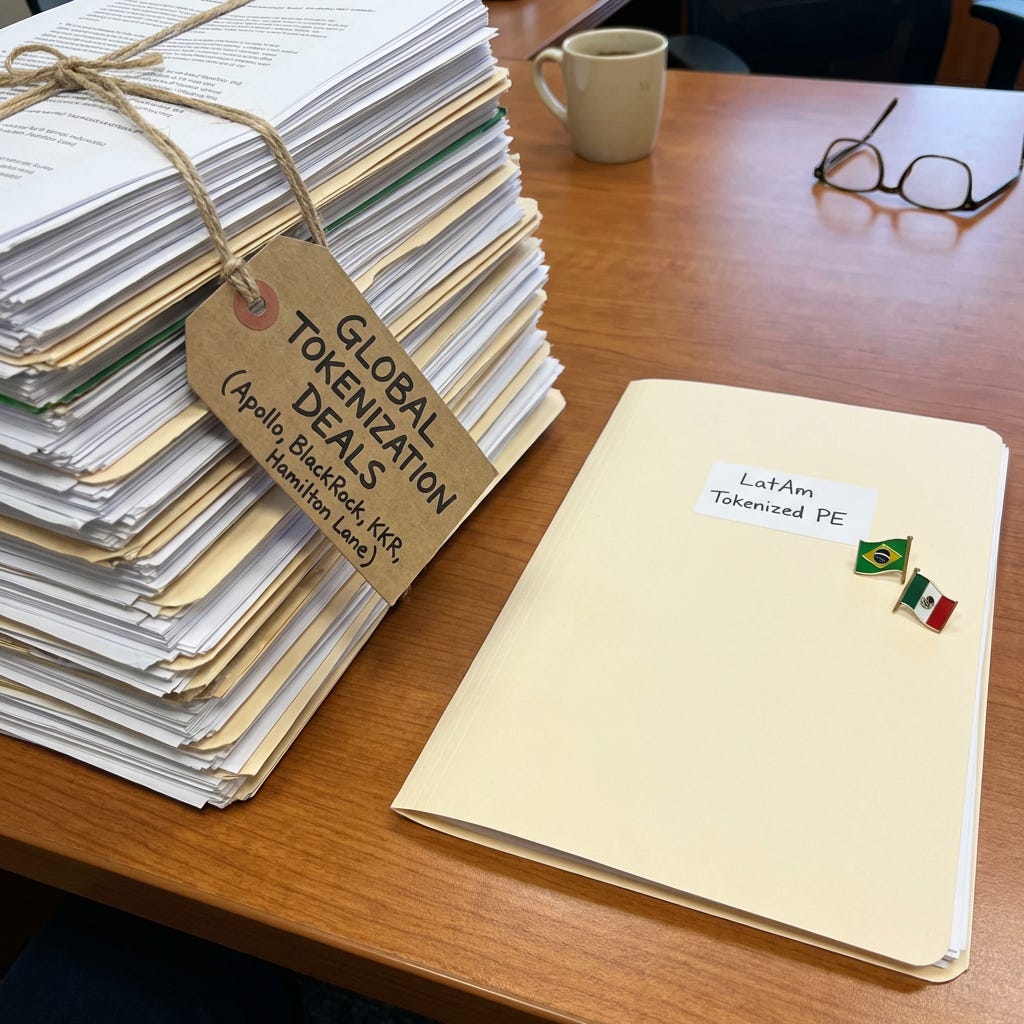
In January 2025, Apollo launched a tokenized diversified credit fund on six blockchains. By November, it had $170 million in assets under management. Hamilton Lane tokenized a feeder fund for its Secondary Fund VI on Polygon, dropping the minimum investment from $5 million to $20,000. KKR put a health care growth fund on Avalanche. BlackRock’s BUIDL, the tokenized U.S. Treasury product that became the proof of concept for institutional tokenization, peaked at $2.9 billion in AUM and is now accepted as trading collateral on Binance.
The largest alternative asset managers in the world have moved. They did it through Securitize, which now manages $4 billion in tokenized assets and is going public at a $1.25 billion valuation via a Cantor Fitzgerald SPAC, with BlackRock, ARK Invest, Hamilton Lane, and Morgan Stanley rolling their stakes at 100%.
Now look at Latin America. The region deploys $15.5 billion a year in private equity across more than a thousand deals. Patria Investments manages over $48 billion in alternatives. Vinci Partners runs one of the largest infrastructure platforms in the region. XP Inc. sits on R$1.9 trillion in client assets. BTG Pactual is the biggest investment bank in Latin America.
Not one of them has a tokenized product.
The only institutional tokenized asset ever issued by a major LatAm financial institution is BTG Pactual’s ReitBZ, a $15 million real estate security token on Tezos. It launched in 2019. It paid its first dividends in 2020. And then nothing. No follow-on product from BTG. No response from any competitor.
That silence is about to break.
Welcome to Emerging Fintech 👋🏻, your weekly deep dive into venture capital and fintech across emerging markets. If someone forwarded this to you, subscribe to get insights like this delivered weekly.
This edition is sponsored by Angel Squad - Join 2,000+ members from Apple, Nike, Stripe & Meta learning Hustle Fund’s proven frameworks. Access curated deals from our 1,000+ monthly pipeline (we share the top 0.5%), weekly live pitch sessions, and global networking in 20+ cities. Squad members have invested $30M+ in 70+ companies alongside Hustle Fund. Start your 30-day free trial → https://go.angelsquad.co/gBk0

The demand catalyst no one is talking about
The supply side of LatAm tokenization gets most of the attention. Infrastructure platforms, regulatory sandboxes, blockchain partnerships. But the most consequential development is on the demand side, and it happened in Mexico.
Mexico’s AFOREs (pension funds) grew to $409 billion in AUM as of June 2025. Recent regulatory reforms now permit up to 30% allocation to private equity, credit, and alternative investments. That is roughly $123 billion in potential alternative allocation from a single institutional channel.
This is where tokenization becomes a distribution story, not a technology story. Traditional PE fund structures require high minimums, long lock-ups, and complex subscription processes that make it difficult for pension funds to diversify across many managers. Tokenized fund interests solve this mechanically. Lower minimums. Programmable distributions. Secondary market liquidity. If a single Mexican AFORE allocated 5% of its alternatives budget to tokenized products, that is $6 billion. More than every LatAm tokenization platform has processed combined.
The structural pressure is already visible. In H1 2025, secondaries reached a record 28% of LatAm PE exits, totaling $6.2 billion in realizations. When nearly a third of PE exits are happening through secondary sales, the market is telling you it has a liquidity problem. Tokenization is the liquidity answer.
High-net-worth individuals plan to allocate 8.6% of their portfolios to tokenized assets by 2026. The institutional comfort with digital assets is not hypothetical. It is measured.
The legal architecture is being mapped in parallel. Perez-Llorca published an analysis of how tokenized LP interests and private securities could work across Colombia, Mexico, Spain, and Brazil. Law firms do not publish cross-border tokenization frameworks for academic exercise. They publish them because clients are asking.
The infrastructure is ahead of the institutions
The conventional explanation for LatAm’s tokenization gap is that the region lacks infrastructure. That was true in 2021. It is no longer true.
Liqi Digital Assets, founded in 2021 and backed by Kinea Ventures (Itau Unibanco’s VC arm) and Oliveira Trust, has surpassed $100 million in tokenized real-world assets on the XDC Network. Its pipeline targets $500 million across private credit, receivables, corporate debt, agribusiness instruments, and real estate. These are the same structured credit instruments that Brazilian institutional investors already understand. CRIs, CRAs, receivables, corporate debt. Now with programmable distribution and fractional access.
Mercado Bitcoin, which partnered with Polygon Labs to build its tokenization infrastructure, has issued 340+ tokenized products totaling roughly $180 million. It previously tokenized over R$1 billion in private credit on the XRP Ledger. By volume, it ranks as the third-largest private credit tokenization platform in the world, behind only firms operating in the U.S. and Europe.
BLOCKBR is building white-label tokenization platforms that handle the full stack from legal analysis to settlement. This is production infrastructure, not pilot programs.
On the regulatory side, the momentum is real. Brazil’s CVM opened a public consultation from September to December 2025 to reform Resolution 88, its equity crowdfunding regime, specifically to accommodate securitization and asset tokenization. If this reform produces a viable framework for tokenized fund share distribution, it removes the single largest regulatory barrier to institutional adoption. The CVM sandbox has already authorized tokenized CRI (Real Estate Receivables Certificates) issuance, and CRI volume grew 21.6% with transactions up 35.3% under this regime.
Argentina’s CNV is doing something unexpected. Resolution 1081, published in August 2025, expanded the country’s tokenization sandbox to include securities: shares, corporate bonds, and CEDEARs (Argentine depositary receipts for foreign securities). Only fully registered VASPs can act as depositaries, which means this is supervised tokenization, not a crypto free-for-all. The sandbox runs through August 2026. It is the most progressive securities tokenization framework in Latin America.
Like this article? Subscribe for more fintech analysis.
The platform battle: Securitize vs. Liqi vs. Everyone Else
Every major global PE tokenization runs through Securitize. Apollo, Hamilton Lane, KKR, BlackRock. It is a $1.25 billion company with zero presence in a region that deploys $15.5 billion a year in PE. That gap will not last.
The question is how it closes. Three scenarios are plausible.
Securitize partners with a major LatAm bank. This is the most likely path. Securitize already has relationships with the global LPs that invest in LatAm funds. BTG Pactual has the institutional credibility and a dormant tokenization capability from ReitBZ. XP has 3 million active clients and the distribution infrastructure to place tokenized products at scale. A Securitize partnership with either would immediately create the most credible tokenization platform in the region. The risk is speed. Securitize has shown no urgency in LatAm, and large bank partnerships take 12 to 18 months to operationalize.
Liqi scales fast enough to become the regional standard. Liqi has the Itau backing through Kinea Ventures, a $500 million pipeline, and deep knowledge of Brazilian structured credit instruments. Its advantage is specificity. It understands CRIs, CRAs, and the receivables structures that institutional Brazilian investors already use. If Liqi can convert its pipeline into AUM before Securitize arrives, it becomes the default infrastructure layer for LatAm PE tokenization. The challenge is that Liqi’s current AUM ($100 million) is a fraction of what Securitize processes globally ($4 billion). Institutional credibility takes time to build.
A global custodian builds the middleware layer. This is the dark horse. Fireblocks already provides custody and settlement infrastructure for tokenized assets globally. If a custodian or middleware provider builds a LatAm-specific tokenization layer that any asset manager can plug into, the platform question becomes less relevant. The asset manager picks the custodian, not the tokenization platform. This scenario favors fragmentation over consolidation, but it also lowers the barrier for the first major LatAm GP to move.
The collision between global platforms and local infrastructure will define who captures the tokenization fee layer in LatAm for the next decade.
Who moves first
Every financial market follows the same sequence. The instruments are created. The infrastructure is built. Regulation provides the framework. Then the institutions move. In LatAm tokenization, the first three stages are underway simultaneously. Liqi and Mercado Bitcoin have built the rails. Brazil’s CVM and Argentina’s CNV are writing the rules. The global PE firms have proven the model.
The missing piece is the institutional commitment. The firms that control the capital have not yet moved onto the infrastructure that has been built for them. Three candidates stand out.
BTG Pactual is the only major LatAm institution that has actually issued a tokenized security. ReitBZ was small ($15 million) and had no follow-on, but it means BTG has institutional memory. Its team has been through the legal structuring, the custody decisions, and the compliance process. Restarting is easier than starting from scratch. BTG also operates the largest investment bank in Latin America, which gives it placement capability across institutional and HNW channels. The risk is that BTG’s 2019 experiment may have been filed as a one-off innovation project rather than a strategic priority.
XP Inc. has the distribution advantage. R$1.9 trillion in client assets and 3 million active clients make it the largest independent investment platform in Brazil. If XP launched a tokenized fund product, it could place it across its existing client base without building new distribution infrastructure. XP’s challenge is that it has no tokenization history. It would need to partner with Liqi, Securitize, or build its own platform. But distribution wins markets, and no one in LatAm has more of it.
Patria Investments has the AUM ($48 billion) and the GP credibility. It is the closest LatAm equivalent to the global firms that have already tokenized. A Patria tokenized fund would carry the institutional weight that the market is waiting for. But Patria has shown no public interest in tokenization, and its investor base (large institutional LPs) may see less immediate value in fractional access than retail-facing platforms.
Less than 5% of Latin Americans invest in capital markets. LatAm PE suffers from a liquidity discount that depresses valuations and limits participation. Tokenization removes that structural barrier by making institutional-grade products fractional, programmable, and accessible on a smartphone.
The first major LatAm PE firm to tokenize fund interests will not just launch a product. It will reprice the liquidity premium for an entire region.
Sources: